When you buy through links on our articles, Future and its syndication partners may earn a commission.

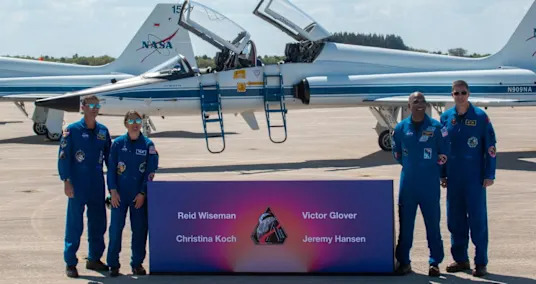
CAPE CANAVERAL, Fla. — The crew of Artemis 2, NASA's first launch to the moon in over half a century, has arrived at the Kennedy Space Center ahead of their mission.
NASA astronauts Reid Wiseman, Victor Glover and Christina Koch, and Canadian Space Agency (CSA) astronaut Jeremy Hansen piloted T-38 jets from the Johnson Space Center in Houston to touch down on the runway at KSC's Shuttle Landing Facility at 2:15 p.m. EDT (1915 GMT) today (March 27), here on the Space Coast.
The quartet are poised to launch aboard NASA's Space Launch System rocket (SLS) as soon as April 1, and will fly the agency's Orion spacecraft on a 10-day mission around the moon and back to Earth. It's the first crewed mission of NASA's Artemis program to establish a sustained human presence on the moon, and the first to launch astronauts there since Apollo 17, in 1972.
The crew have been in quarantine since March 20, when SLS was rolled from KSC's Vehicle Assembly Building (VAB) to the pad at Launch Complex-39B (LC-39B). Now at their last terrestrial stop before heading to space, the Artemis 2 astronauts will remain in quarantine through the remainder of the mission's upcoming launch window, which extends through April 6.
It was the second such rollout for the Artemis 2 SLS, which NASA was forced to roll the rocket back to the VAB from the pad after its initial rollout earlier this year due to maintenance issues discovered during prelaunch tests in February.
Artemis 2 is designed as a stepping stone for the Artemis program, and will test Orion's life support systems in space with astronauts aboard for the first time. The crew won't land on the moon during Artemis 2, but will instead fly in a loop around its far side on a course known as a free-return trajectory. This is a path that flies Orion to lunar space on a direct path back to Earth to avoid the need for any major firings of the spacecraft's engine after its translunar injection burn that will put it on a course for the moon.
Assuming no major issues crop up during the Artemis 2 mission, NASA is planning a demonstration with Orion and the Artemis lunar landers to take place on Artemis 3 in Earth orbit next year. Following that, and pending the readiness of one of those landers, the agency is aiming for the program's first lunar landing on Artemis 4 in 2028. Beyond that, NASA hopes to begin laying the architecture for a more permanent lunar presence through the 2030s with habitats, rovers and regular cargo landers to establish a sustained outpost on the moon's surface.
"We're not trying to get it right out of the gate," Isaacman said to media after the astronauts' arrival. "In fact, it's a test and experimentation phase — lots of rovers, lots of landers ... That means lots of opportunity for scientific and technological payloads that we can incorporate."


"It's awesome to be here. We love coming here," Wiseman said on the tarmac on Friday afternoon. "About 100 miles away, we said how much we love sliding to KSC."
In his remarks, Wiseman also thanked members of NASA's astronaut office for their support. "I just want to send a special thank you to our AOD team. They pulled a lot together to make this possible for us to get to fly these jets and stay in quarantine and have all the support," he said.
If NASA's schedule holds, the Artemis 2 crew will transfer to KSC's Neil Armstrong Operations and Checkout facility (O&C), appropriately named for one of the first human to walk on the moon, early Wednesday to begin donning their spacesuits, as mission teams work through launch countdown procedures to fuel SLS.
NASA plans to begin fueling SLS with the rocket's volatile, cryogenically-cooled liquid hydrogen and liquid oxygen propellants at 7:45 a.m. EDT (1245 GMT) on Wednesday, with liftoff scheduled during a two-hour launch window that opens at 6:24 p.m. EDT (2324 GMT). Should mission operators encounter any delays and need to postpone the launch for another day, NASA is able to reset SLS for up to four attempts between April 1-6, with another window opening April 30 should the first week of the month become unviable.
LATEST POSTS
- 1
 6 Vehicle Rental Administrations: Pick Your Ideal Ride
 - 2Novo Nordisk slashes prices of popular weight loss and diabetes drugs
- 3Instructions to Figure out the Various Phases of Cellular breakdown in the lungs
- 4One-third of asylum applications by Iranians approved in Germany
- 5Why this Tennessee special election has the 'whole world' watching




- How to see the Ursids, the final meteor shower of 2025
- A few Exemplary Chinese Dishes, Which Are Famous Around the world
- 10 Hints for a Fruitful New employee screening
- 7 Fun Plans to Make Film Evenings Seriously Invigorating (You'll Cherish #5!)
- RFK Jr. succeeds in changing hepatitis B recommendation | The Excerpt
- Overlooked infertility care should be part of national health services, says WHO
- The Fate of Rest: Patterns in Shrewd Beds
- Evidence of lost baptismal rite stage uncovered in Byzantine era cathedral near Sea of Galilee
- ‘Democratizing space’ is more than just adding new players – it comes with questions around sustainability and sovereignty